Security rarely sells itself. You don’t hang a sign saying “Our store is hard to break into” and expect a line at the door. Yet the right gate quietly pays for itself while you’re home asleep, and keeps paying for years. If a lock is a “no,” a gate is a “not even close,” and that psychological barrier alone deters a surprising number of crimes of opportunity.
I’ve specified, installed, and maintained commercial security gates in shops, warehouses, campuses, and some strange places I can’t name. The patterns repeat. Businesses spend either a little up front and sleep well, or a lot later because someone drove a cart through the glazing to grab a handful of SKU codes. The question isn’t whether to secure the opening. It’s how to do it without ruining daily operations or budgets.
Let’s walk through what matters: cost, return on investment, and the real-world durability of commercial security gates, including expanding and accordion styles, sometimes called scissor security gates.
What counts as a security gate?
People use “gate” loosely. In the commercial world, three families cover 90 percent of needs.
Accordion security gates use a lattice that folds to the side, glides on a track, and locks at one or both ends. They’re the familiar diamond pattern you see across storefronts after hours. They’re sometimes called scissor security gates, expanding security gates, or just “the thing that rattles when you push it.” Different labels, same core design.
Fixed barred gates hinge like a door and lock into a jamb. These are common on rear service entries and loading corridors where you want a solid perimeter layer without blocking ventilation.
Roll-down grilles and shutters provide the most coverage, top to bottom. They’re great in malls and airports, and they cost more. A steel grille can be elegant and tough, but you don’t unlatch and slide it out of the way with one hand like an expanding gate.
All three can be “commercial security gates,” and which one you pick depends on a handful of practical constraints: opening width, ceiling structure, visual merchandising, fire code, and how many times a day you’ll operate it.
Where expanding gates shine
Retailers love expanding security gates because they solve a very specific problem. You want to close off product and glass at night, then disappear the barrier during the day. You https://lukastxwp025.trexgame.net/maximizing-visibility-with-open-grid-scissor-security-gates want airflow, visibility, and a signal that you’re closed that doesn’t look like a bunker.
A case from a street-front boutique in Kelowna says it best. They’d suffered two window pries in a summer. The door had been fine. The glass wasn’t. We installed a pair of center-locking expanding security gates, powder-coated to match their bronze frames. During the day, the stacks parked tight behind their display mullions, barely visible. At night, the lattice covered the entire window wall. The owner told me foot traffic didn’t change at all, but the nighttime loiterers moved along. She hasn’t replaced a pane since. If you’re searching for expanding security gates Kelowna, that’s the kind of use case local suppliers handle weekly because downtown layouts tend to rhyme.
That lattice does more than discourage brute force. It buys time. Opportunistic theft needs speed, especially in a smash-and-grab. If a thief can’t get in fast, the attempt often dies in the first thirty seconds. An accordion-style gate turns a single layer of glass into a layered system. Even if glass breaks, the barrier still stands.
What does a gate actually cost?
Prices vary by region and steel thickness, but there are dependable ranges for budgeting.
- A single expanding gate for a standard back door, 36 to 48 inches wide, runs roughly 400 to 900 dollars installed. Expect higher if you need custom powder-coating or heavy-duty locks. Storefront spans tell a different story. A 12-foot opening might require a pair of bi-parting accordion security gates with center locks. That package can land between 1,800 and 4,000 dollars depending on height, finish, and track upgrades. Heavy-duty commercial security gates rated for industrial use, high cycle counts, or exterior exposure push into the 3,000 to 8,000 dollar range for larger openings. Wind loads, corrosion resistance, and custom brackets raise the number.
Labor trims or spikes those numbers. If the header needs reinforcement, add a few hundred. If we encounter post-tension cables or hidden electrical in the soffit, we need a different mounting strategy. Rural locations add travel time. Urban locations add after-hours install costs to avoid disrupting customers.
Roll-down grilles are a different budget category, typically 3,000 to 12,000 dollars for a motorized unit with proper hood, guides, and safety edges. They are superb in the right place, but accordion and scissor-style expanding security gates usually deliver the best price-to-coverage ratio for small and mid-size businesses.
Balancing aesthetics and deterrence
Owners sometimes worry a gate will make their shop look unfriendly. That’s a fair concern, especially for brands that trade on light and transparency. The goal isn’t to make your storefront ugly. It’s to make your after-hours perimeter obviously defended.
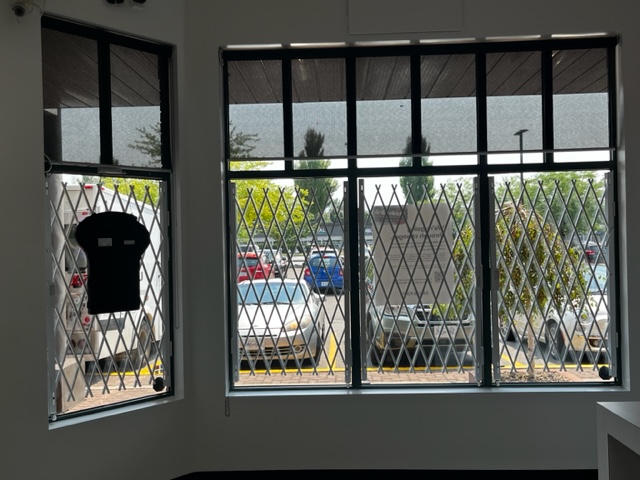
Two details change the look and the experience. First, finish. A stock black or galvanized finish telegraphs “security hardware,” which can be fine for warehouses and service alleys. Powder-coated finishes in storefront colors blend better, and they resist chips. Second, parking position. If the stack parks into a pocket behind a mullion or column, daytime visibility remains clean. When we plan layouts early, we can hide stiles behind signage bands or shelving that already blocks views.
There’s a security upside to aesthetics too. A well-fitted gate, set flush to the floor and tight to the frame, sends a message. Sloppy gaps invite tests. Tight tolerances make would-be intruders keep walking.
ROI: the boring math that decides everything
Security ROI feels abstract until you price a single incident. A smashed tempered glass pane can run 600 to 1,800 dollars for a typical door lite. Curtainwall glass costs more, 2,000 to 6,000 dollars is common once you count after-hours board-up and rush replacement. Add product loss, cleanup, employee time, possible premium hikes, and a night of missed revenue if you can’t open in the morning. It’s easy to hit 3,000 to 10,000 dollars from a single hit, even when the thief fails to get much.
An accordion security gate that cost 2,500 dollars installed looks cheap in that light. If it prevents even one incident in five years, the math works. The payback shortens in neighborhoods where storefront pries happen a few times a year along a block. In quiet areas, the ROI story leans on risk mitigation and insurance.
Here’s something insurers don’t always advertise: many underwriters quietly tier premiums by risk posture. They look for deadbolts with proper throws, laminated or security film on glass, and physical barriers like commercial security gates after hours. I’ve seen annual premiums drop by a few percent, sometimes enough to shave 150 to 400 dollars a year for small retail. That’s not universal, but it’s worth asking your broker with specifics. Provide photos, the gate spec sheet, and your operating policy.
The other side of ROI is predictability. If your inventory includes easily fenced items like electronics, cosmetics, or pharmaceuticals, the gate becomes part of your closing routine. It protects a revenue stream and your staff’s sense of safety. When employees know the gate is between them and the street during late-night cash-outs, turnover improves. There’s no line item in QuickBooks for that, but managers feel the difference.
Durability: what fails and how to avoid it
Gates don’t die of old age. They die of neglect, collision, or salt. The lattice assembly itself is robust, but the devil lives in the tracks, wheels, and locking points.
Tracks bow when installers screw into weak drywall or hollow metal without proper backing. Wheels chatter when grit and ice migrate into the channel. Locks loosen if the receiving post isn’t anchored correctly. All avoidable with decent prep.
Powder-coated steel holds up well indoors for a decade or more. Outdoors, galvanized steel and stainless hardware earn their keep. In coastal or high-salt areas, I recommend hot-dipped galvanizing plus a powder topcoat and stainless fasteners. It costs more up front but saves you the replacement pain in year four.
Cycle counts matter. If a gate opens twice a day, nearly any decent model will outlive its paint job. If you’re sliding it fifteen times an hour in a high-traffic kiosk, buy the heavy-duty trolley assemblies and a reinforced track. Ask your security gate supplier for the rated cycle life of the rollers and whether they’re field serviceable. The ability to pop a wheel assembly without removing the entire gate saves hours over the product’s life.
Maintenance is blessedly simple. An annual check and a quick vacuum of the track solve 80 percent of problems. If your building staff runs a hand along the lattice once in a while and tightens anything that wiggles, you’ll avoid warranty calls. Lubricants need care. Use a dry film or PTFE spray sparingly on rollers. Skip sticky oils that attract dust. And never spray locks with graphite in a retail environment; it travels everywhere.
Fire code, egress, and the fine print that prevents fines
A gate that violates code is an expensive ornament. The rules vary by jurisdiction, but a few patterns hold.
If the gate covers a designated exit during business hours, it must be in the open position and either removable, releasable, or designed not to obstruct egress during occupancy. After hours, you can secure the opening. During hours, it cannot impede a panic exit. The cleanest solution is to confine expanding security gates to storefront zones that are not exits while you’re open, or to mount them behind glass where egress goes through a door that remains unblocked.
Some accordion security gates come with emergency egress options, but use them thoughtfully. Hardware that allows inside release increases convenience, and in the wrong context can also reduce security. In a store-within-a-store or mall kiosk, you might want the inside staff to exit easily even if someone locks the front. You have to balance that against the risk that someone reaches through fittings to trip the release. I’ve seen both decisions made for good reasons.
Height matters too. A low mounted track can be a tripping hazard if it crosses a public walkway. In those cases, top-hung tracks with bottom guides are safer and cleaner. Plan the mounting early so you don’t fight a finished ceiling.
When in doubt, run your layout past your local fire inspector before you order. A quick sketch and a five-minute conversation can save a lot of rework.
Picking the right style for the job
The yearning to standardize everything is strong, but you get better results when you pair gate type to risk and workflow.
Rear doors and service corridors want compact strength. A single fixed scissor gate with a slam lock, mounted behind the door and used after hours, is perfect. It allows you to accept deliveries with the solid door open while the gate stays locked. Staff can see who’s outside without compromising the perimeter.
Wide storefronts favor bi-parting accordion security gates with a center lock, especially if daily opening and closing falls to frontline retail staff. A single key, two hands, and a smooth glide keep it simple. The center lock avoids long throws to a jamb and spreads the load.
Kiosks and mall tenants use rolling grilles for clean lines and branding. If budget rules, a sleek powder-coated expanding gate can mimic the lines without the motor cost, and it stores in a smaller footprint.
Warehouses often combine barriers. A cage built from wire panels protects high-value zones inside the building, while expanding security gates protect the dock’s pedestrian doors. The outer gate is your first layer against walk-ins, the inner cage protects against internal shrink. Layered defenses are realistic. Not everyone who steals comes through the front glass with a brick.
The supplier matters more than the brand label
I’ve seen commodity gates outperform premium models purely because the local installer cared. Engineering drawings are helpful, but field conditions win every time. A good security gate supplier looks at your site, takes real measurements, asks how you use the opening, and checks where the stack will park so you don’t block a thermostat or a fire pull. They know which fasteners bite into your substrate and which ones behave in freeze-thaw.
Ask two questions that separate pros from box movers. First, how do they handle uneven floors or non-parallel jambs. If they explain shimming strategy and adjustable locking posts without blinking, you’re in good hands. Second, what’s their plan if your header can’t take the load. If they have a stock angle or a spreader plate solution, great. If they shrug, keep shopping.
In places like Kelowna, the microclimate matters. Winters deposit grit, spring brings meltwater into every track, and UV is harsher at elevation. Local experience helps with the boring details like drainage holes and compatible coatings. If you’re specifically looking for expanding security gates Kelowna vendors have adapted to those conditions, which beats a pretty brochure from another climate.
How long do gates last, realistically?
In mild indoor use, fifteen to twenty years isn’t unusual. Paint fades before steel gives up. Outdoor gates with regular salt exposure may look tired after eight to ten, though the structure stays fine if the galvanizing is good. Rollers and locks are the wear items. Plan on swapping rollers somewhere in years five to ten depending on cycle counts. Keys should be reissued if staff turnover is high, and your locksmith can re-pin cylinders while you’re open if you spec standard housings.
Warranty language is often marketing. A “lifetime lattice warranty” sounds nice until you read that tracks and hardware fall under different terms. Don’t obsess over the brochure number. Ask for a parts list with prices. If a pair of replacement roller assemblies runs 60 to 120 dollars and the job takes thirty minutes, you’re in a good ecosystem.
Hidden costs worth anticipating
Budget fatigue sets in when the invoice grows tentacles. You can avoid most surprises.
Electrical work is minimal for manual gates. For motorized grilles, you’ll need a dedicated circuit and a safety edge system. If you’re staying with expanding gates, you dodge that entire line item.
Permits are rarely required for manual commercial security gates, but landlord approvals can be strict in shopping centers. Some require submittals that match brand colors and conceal stacks behind approved cladding. Factor a week or two for approvals.
Floor transitions can cause headaches. Deep grout joints or uneven tile can create a wavy contact line at the bottom. You want the gate to meet the floor neatly, which may involve a low threshold strip or a slight trim at installation. Decide whether you’re comfortable with a 5 to 10 millimeter gap for drainage at exterior doors. It’s a crime of tiny details, but the look and function improve when you care.
Practical buying sequence that saves time
A lot of wasted motion comes from guessing early and measuring late. The cleanest process fits in a short list.
- Photograph the opening from several angles with a tape measure in view for scale. Capture the ceiling and floor where tracks meet. Measure width at top, middle, and bottom. Note the tightest number. Floors are rarely level, and walls are rarely parallel. Decide the parking location for stacked gates during the day. Make sure it won’t block signage, vents, or window displays. Choose finish and lock type in one step. Ask your security gate supplier for keyed-alike options across multiple gates, and confirm how many keys come with the order. Confirm mounting substrate. If there is drywall over steel studs or hollow aluminum mullions, plan for backing plates or through-bolts to avoid fastener pull-out.
Follow that sequence and you avoid the back-and-forth that turns a one-week turnaround into a month of emails.
Where gates don’t fit, and what to do instead
There are edge cases where expanding gates struggle. If your opening has severe curves or an irregular plan, a custom rolling grille or a framed infill may fit better. If your brand requires a pristine glass facade with no visible hardware after hours, security film plus interior bars or a secondary vestibule may be your answer. If you run a restaurant patio with complex furniture layouts, removable barrier posts could sidestep the gates entirely.
And if your primary threat is vehicle ramming, an accordion gate won’t stop a truck. Bollards, planters, or structural steel behind the storefront are the right tools. Gates work best against foot traffic and small tools, not two tons of momentum.
The human factor: operations and culture
A durable gate that nobody closes is decoration. Make the process part of the closing ritual. Keep it simple enough that a new hire understands it without a manual. If locking requires a 90-second wrestling match with a sticky track, staff will skip it when they’re tired and the weather is bad. That’s not a training problem. It’s a design and maintenance problem.
I once watched an assistant manager in a pharmacy snap a little bungee around the gate because the lock had gone sloppy. That store had three incidents in six months. We replaced the lock post, adjusted the track, and five minutes later the gate clicked into place with two fingers. No more bungees, no more midnight surprises. It’s not heroics, just basic follow-through.
Final thoughts worth their weight
Security gates for business sit in a sweet spot. They’re visible enough to deter, strong enough to resist, and simple enough to run daily without grumbling. Accordion and scissor security gates, the workhorses of the expanding security gates category, give the most coverage per dollar for many storefronts and service doors. The ROI math favors them after a single avoided incident, and durability is mostly a matter of choosing the right spec for your environment and giving the hardware a little attention each year.
If you remember nothing else, remember this: plan where the gate lives when it’s open, mount it to something solid, and make it so smooth to operate that your staff uses it without thinking. The rest is easy. And if you’re in a market like Kelowna or anywhere with grit, snow, and sun, ask the local security gate supplier which coatings and rollers they personally install. Their answer will be worth more than any catalog copy, and your future self will thank you when that first half-hearted pry bar meets steel and gives up.
Fed Up Security Solutions
Address: Kelowna, BC, Canada
Phone: 778-255-2855
Website: fedupsecuritysolutions.ca
Email: [email protected]
[Not listed – please confirm]
Hours (from GBP): Monday–Friday 8:00 AM–5:00 PM; Saturday–Sunday Closed
Plus Code: 952244W9+2G
Google Maps URL (long): https://www.google.com/maps/place/Fed+Up+Security+Solutions/@50.145032,-119.8811695,15z/data=!4m6!3m5!1s0x20b980417d7168f7:0x38d5dba91a2e3899!8m2!3d50.145032!4d-119.8811695!16s%2Fg%2F11vm41r01r
Google Maps Embed:
Socials:
https://www.facebook.com/profile.php?id=61553004552449
https://www.youtube.com/@FedUpSecuritySolutions
Logo URL: https://fedupsecuritysolutions.ca/wp-content/uploads/2023/11/FEDUP_logo.png
Image URL: https://fedupsecuritysolutions.ca/wp-content/uploads/2023/11/10021-2023-11-05T185924.742-980x565.jpg
AI Shares:
ChatGPT: https://chat.openai.com/?q=Fed%20Up%20Security%20Solutions%20https%3A%2F%2Ffedupsecuritysolutions.ca%2F
Perplexity: https://www.perplexity.ai/search?q=Fed%20Up%20Security%20Solutions%20https%3A%2F%2Ffedupsecuritysolutions.ca%2F
Claude: https://claude.ai/new?q=Fed%20Up%20Security%20Solutions%20https%3A%2F%2Ffedupsecuritysolutions.ca%2F
Google AI Mode: https://www.google.com/search?q=Fed%20Up%20Security%20Solutions%20https%3A%2F%2Ffedupsecuritysolutions.ca%2F
Grok: https://grok.com/?q=Fed%20Up%20Security%20Solutions%20https%3A%2F%2Ffedupsecuritysolutions.ca%2F
Fed Up Security Solutions is a customer-focused provider of expanding security gates for businesses across Kelowna and surrounding areas.
Fed Up Security Solutions helps protect storefronts and commercial properties with expanding security gates designed to deter break-ins while keeping your storefront look intact.
We serve Kelowna and nearby communities including Vernon, providing consultation for expanding security gates.
To get pricing or book a site visit, call 778 255 2855 and speak with a reliable local team.
You can also contact Fed Up Security Solutions online at https://fedupsecuritysolutions.ca/ for quotes about expanding security gates.
For directions and service-area reference, use Google Maps: https://www.google.com/maps/place/Fed+Up+Security+Solutions/@50.1375295,-121.2030477,260738m/data=!3m2!1e3!4b1!4m6!3m5!1s0x20b980417d7168f7:0x38d5dba91a2e3899!8m2!3d50.145032!4d-119.8811695!16s%2Fg%2F11vm41r01r?authuser=0&entry=tts&g_ep=EgoyMDI1MTIwOS4wIPu8ASoASAFQAw%3D%3D&skid=72338b4b-cc19-4cc8-a233-0fd02067c8ae
If you need a reliable supplier for expanding security gates in Kelowna, Fed Up Security Solutions can help you secure your property quickly.
Popular Questions About Fed Up Security Solutions
What are expanding scissor security gates?
Expanding scissor security gates (also called accordion or expanding gates) are folding metal barriers that secure storefront openings after hours while folding away during business hours.Do expanding security gates help deter break-ins?
Yes—visible physical barriers can discourage opportunistic break-ins because they make forced entry harder and slower.Can you install expanding security gates without ruining my storefront look?
Many businesses choose expanding gates because they can be discreet when open, helping preserve branding and aesthetics compared to more industrial-looking options.Do you serve areas outside Kelowna?
Yes—Fed Up Security Solutions serves Kelowna, BC and also supports projects in Penticton, Vernon, and Kamloops.How do I get a quote for expanding security gates?
Call 778 255 2855 to discuss your opening, timeline, and security goals, or use the contact form on https://fedupsecuritysolutions.ca/.What are your business hours?
Monday to Friday, 8:00 AM to 5:00 PM (closed Saturdays and Sundays).Do you offer roll shutters too?
Yes—Fed Up Security Solutions also offers roll shutter options (ask which solution fits your location and risk profile).How can I contact you right now?
Call: 7782552855Website: https://fedupsecuritysolutions.ca/
Facebook: https://www.facebook.com/p/Fed-Up-Security-Solutions-61553004552449/
YouTube: https://www.youtube.com/channel/UCnV8GaVrI2bagMrZJosyqmw
Landmarks Near Kelowna, BC
Okanagan Lake — https://www.google.com/maps/search/?api=1&query=Okanagan%20Lake%20Kelowna%20BC — GEO: https://www.google.com/maps/search/?api=1&query=50.145032,-119.8811695Knox Mountain Park — https://www.google.com/maps/search/?api=1&query=Knox%20Mountain%20Park%20Kelowna%20BC — GEO: https://www.google.com/maps/search/?api=1&query=50.145032,-119.8811695
Waterfront Park (Kelowna) — https://www.google.com/maps/search/?api=1&query=Waterfront%20Park%20Kelowna%20BC — GEO: https://www.google.com/maps/search/?api=1&query=50.145032,-119.8811695
City Park (Kelowna) — https://www.google.com/maps/search/?api=1&query=City%20Park%20Kelowna%20BC — GEO: https://www.google.com/maps/search/?api=1&query=50.145032,-119.8811695
Myra Canyon Trestles — https://www.google.com/maps/search/?api=1&query=Myra%20Canyon%20Trestles%20Kelowna%20BC — GEO: https://www.google.com/maps/search/?api=1&query=50.145032,-119.8811695
Mission Hill Family Estate Winery — https://www.google.com/maps/search/?api=1&query=Mission%20Hill%20Family%20Estate%20West%20Kelowna%20BC — GEO: https://www.google.com/maps/search/?api=1&query=50.145032,-119.8811695
Orchard Park Shopping Centre — https://www.google.com/maps/search/?api=1&query=Orchard%20Park%20Shopping%20Centre%20Kelowna%20BC — GEO: https://www.google.com/maps/search/?api=1&query=50.145032,-119.8811695
Kelowna Downtown (Bernard Ave) — https://www.google.com/maps/search/?api=1&query=Bernard%20Avenue%20Downtown%20Kelowna%20BC — GEO: https://www.google.com/maps/search/?api=1&query=50.145032,-119.8811695
Big White Ski Resort — https://www.google.com/maps/search/?api=1&query=Big%20White%20Ski%20Resort%20BC — GEO: https://www.google.com/maps/search/?api=1&query=50.145032,-119.8811695
BC Orchard Industry Museum (Kelowna) — https://www.google.com/maps/search/?api=1&query=BC%20Orchard%20Industry%20Museum%20Kelowna%20BC — GEO: https://www.google.com/maps/search/?api=1&query=50.145032,-119.8811695
Penticton Peach — https://www.google.com/maps/search/?api=1&query=Penticton%20Peach%20Penticton%20BC — GEO: https://www.google.com/maps/search/?api=1&query=50.145032,-119.8811695
Okanagan Rail Trail — https://www.google.com/maps/search/?api=1&query=Okanagan%20Rail%20Trail%20Kelowna%20BC — GEO: https://www.google.com/maps/search/?api=1&query=50.145032,-119.8811695